The Emperor’s Will and the Duty to Build the Railway
The Narrow Road to the Deep NorthThe Emperor’s Will and the Duty to Build the Railway names the imperial logic that presents construction of the Death Railway as an unquestionable obligation to the Emperor. In the novel, that logic does more than authorize forced labor: it supplies a moral vocabulary through which commanders justify punishment, prisoners are made to seem responsible for their own suffering, and individual guilt is absorbed into the machinery of the railway. Its authority is ultimately undercut by the line’s human cost, its postwar dismantling, and the selective ways its history is remembered.
Imperial purpose and the railway
The doctrine takes material form in a railway planned across Siam toward Burma. In early 1943, Imperial Japanese Army engineers marked its proposed route with surveyors’ pegs: a line of 415 kilometres running from north of Bangkok through to Burma. At first the route was a plan rather than a finished railway, but the Japanese High Command treated it as a necessary answer to a military crisis. The Allies were supplying the Chinese Nationalist Army through Burma, while American control of the seas made transport by water increasingly difficult. Japan wanted a land route to supply its forces in Burma and support its ambitions in India, but lacked the money, machinery, and time to build one by ordinary means.
The railway’s strategic urgency was joined to belief in the Japanese spirit, understood by the Empire as the Emperor’s will and expected to carry it to final victory. That belief helped turn an engineering project into a sacred test of obedience. The project’s scale exposes the contradiction: the railway was treated as an imperative even though its construction depended on human beings compelled to substitute for the equipment, time, and resources the Empire did not possess.
Duty enforced through work and punishment
The doctrine reaches the prisoners as labor before it reaches them as an argument. At the route’s beginning, they receive blunt axes and rotten hemp rope and are ordered to fell, grub, and clear a kilometre of giant teak trees. Elsewhere, orders change even after work is under way. When the Railway Command Group requires a major cutting, already half-completed, to be enlarged by a third for gradient reasons, the alteration adds 3,000 cubic metres of rock to be cut and carried away. The prisoners work by hand with hammers and chisels; the tools are inadequate, and there is not enough coke to sharpen the chisels at the forge. In this material setting, the language of duty makes a demand sound absolute while leaving the means of meeting it to exhausted bodies.
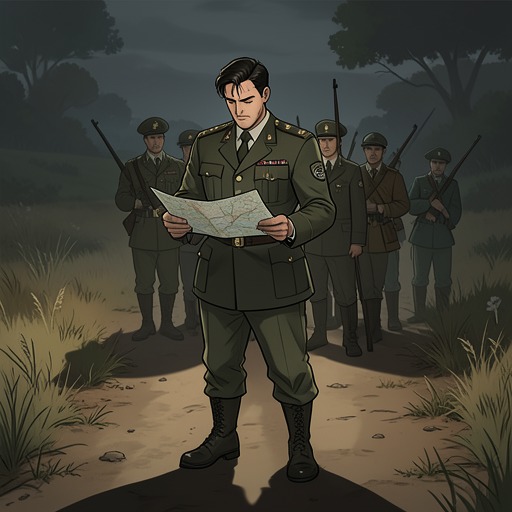
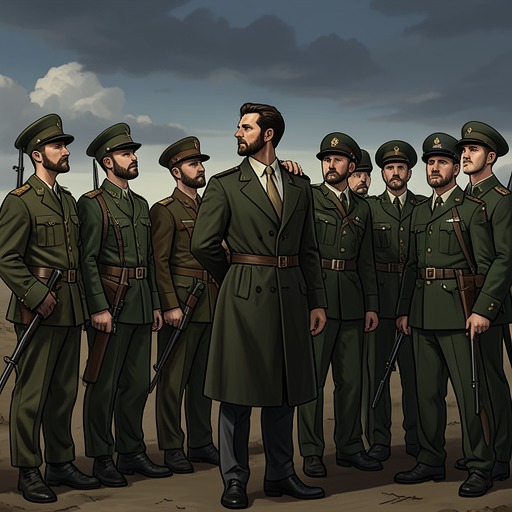
For Major Nakamura, obedience turns punishment into a supposed necessity. As the railway task grows and the prisoners resist, a beating is used to reassert the guards’ authority and remind the prisoners of what their captors call their sacred duty. The punishment also answers the shame Nakamura feels after Colonel Kota discovers missing prisoners. Nakamura’s reasoning is not that the victim is guilty, but that honour and the railway leave no choice: one exists for the Emperor and the railway, which he understands as the embodiment of the Emperor’s will, or has no reason to live or die.
The contradiction becomes especially stark when Dorrigo Evans protests that the man being beaten is sick. Nakamura cannot stop the punishment he ordered, but offers extra quinine so sick prisoners can work. The medicine is framed as help, yet its purpose remains bound to production. Dorrigo Evans recognizes that Nakamura is trying to help where he can, while also seeing that the beating continues and that he himself has arrived too late to save Darky Gardiner. The railway’s demand draws commander, medical officer, guards, and prisoners into different positions within the same violence; duty describes those positions without making them morally equivalent.
The doctrine’s human cost and divided responsibility
The railway’s completion gives the doctrine a measurable human cost. Twenty-two thousand Australian POWs were among the prisoners of the Japanese Empire, and 9,000 were sent to the railway. When steam locomotive C 5631 travelled the completed route on 25 October 1943, towing Japanese and Thai dignitaries, it passed what would include the remains of one in three of the Australians sent to work there. Allied POWs were only part of the labor force: alongside some 60,000 prisoners were a quarter of a million or more Asian laborers. Estimates of the Asian dead range from 50,000 to 200,000, and no agreed total exists. The railway’s official imperative could count distance, deadlines, and output; it could not preserve a full accounting of those consumed in meeting them.
Choi Sang-min’s account shows how the doctrine is internalized below the level of high command. As a Korean sergeant, he had to provide the Japanese engineers with the number of men they required each day and make sure they reached work and continued at it. He regarded hunger, malaria, cholera, and the prisoners’ enslavement as conditions he could not change, and took pride in having completed his section of the line. His sense of achievement grew out of the very system that deprived the prisoners of food and medicine and made death at work an ordinary possibility. The novel thus presents duty not only as an order imposed from above but as a framework through which a subordinate can treat the completion of a task as his sole accomplishment.
Postwar judgment and selective remembrance
After the war, the claim that service to the Emperor could settle the meaning of wartime conduct meets uneven legal judgment. At Choi Sang-min’s two-day Australian military trial, the charge that he participated in the murder of Frank Gardiner was dismissed because the evidence was contradictory. He was nevertheless convicted as a Class B war criminal for ordering the murder of Wat Cooney and for other ill-treatment, including withholding food and medical supplies that led to avoidable suffering and death; he was sentenced to hanging. Choi argued that, as a Korean sergeant, he could not have ordered a prisoner’s death. The prosecution relied on an interrogation in which Colonel Kota said he had, while confused camp records could not establish whether Cooney was still at the camp when the order was supposedly given. Choi also believed that men with connections to Japanese nobility were being freed while lower-ranking Koreans and Formosans were left as scapegoats. The account complicates any simple separation between obedience, individual action, and accountability, without erasing the prisoners’ suffering.
The public commemoration of the railway sharpens that tension. Locomotive C 5631 is displayed at Yasukuni Shrine in Tokyo, where the Book of Souls lists more than two million people who died in service to the Emperor in wars between 1867 and 1951. Enshrinement there carries an idea of absolution, and the names include 1,068 men convicted of war crimes after the Second World War, among them men found guilty of mistreating POWs on the Death Railway. Yet the locomotive’s plaque says nothing about the railway’s construction or its dead. The memorial object preserves the achievement of transport while leaving the people who made it possible largely unrecorded; the novel also stresses that the names of hundreds of thousands of laborers have no equivalent book in which to be remembered.
The railway’s end
The doctrine’s claim to permanence does not survive the Empire’s defeat. With the dream of a global Japanese Empire destroyed, the railway loses its purpose and support. Its Japanese engineers and guards are imprisoned or repatriated, and the remaining laborers are freed. The Thais abandon the line, the English dismantle it, and local people pull up and sell its materials. Rain and time then undo what coercion had built: embankments and bridges wash away, cuttings fill in, and vegetation grows among sleepers and the remains in mass graves.
Decades later, short sections are cleared and made into tourist, sacred, and national sites, but these fragments cannot restore the railway’s original purpose or recover all its dead. The Line is broken and, in the novel’s account, the imperial project has amounted to nothing durable. That ending does not make the labor or deaths unreal; it makes the doctrine’s promise of lasting meaning impossible to separate from the ruins and the missing names. The railway was treated as the Emperor’s will made physical, but its physical form proves temporary, while the duty invoked to build it cannot absolve those who imposed or enforced it.